3 Card Poker India: Rules, Hand Rankings and How to Play
Introduction to 3 Card Poker
3 Card Poker India is a useful search term for players who want to understand a poker variation played with just three cards per hand. Compared with traditional poker formats that use five-card hands or several betting rounds, this game has a simpler structure. Players receive three cards and make decisions based on the strength of their hand and the rules of the particular version.
The name covers a casino-style game commonly played against a dealer. In its standard format, players decide whether to continue after seeing their cards or fold and give up their initial wager. The dealer’s hand is then compared with the player’s hand, provided the dealer meets the game’s qualifying requirement. Some versions also offer a separate side bet, so the available options can differ between platforms.
The appeal lies in how quickly a hand develops. There are fewer cards to assess, and players can learn the basic hand rankings without studying a complicated set of poker rules. Still, a short game is not necessarily an easy way to win. Results depend on the cards dealt, the decisions made, and the payout rules in use.
Basic Rules of 3 Card Poker India
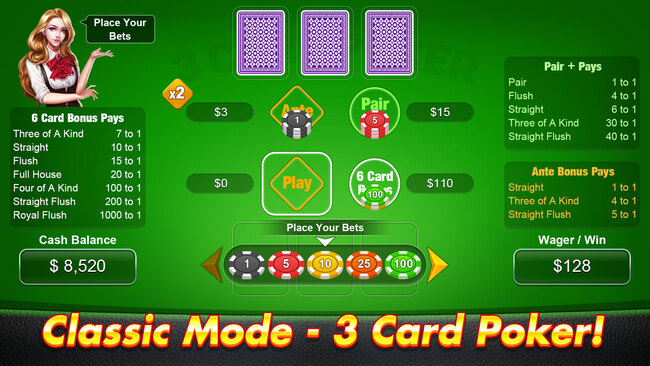
A standard game of 3 Card Poker uses a 52-card deck without jokers. The player and dealer each receive three cards, usually dealt face down. In the common casino version, the player first places an Ante wager before receiving their cards. After looking at the hand, the player decides whether to fold or continue by placing an additional Play wager equal to the Ante.
Folding ends the hand for the player, and the initial Ante is generally forfeited. Continuing allows the player’s hand to be compared with the dealer’s hand. In many standard versions, the dealer must have at least a Queen-high hand to qualify. If the dealer does not qualify, the Ante usually pays even money and the Play wager is returned. If the dealer qualifies, the stronger hand wins according to the game’s rules. Exact settlement terms can vary by version.
Some games also offer a side bet, commonly called Pair Plus, which depends on the player’s three cards rather than whether the dealer wins. This is a separate option with its own payout table, not a requirement for playing the basic game. Before starting, check which bets are available and how each one is settled.
3 Card Poker Hand Rankings
Understanding the hand rankings is essential because three-card poker does not use exactly the same hierarchy as five-card poker. In particular, a straight ranks above a flush in the standard three-card version. A flush is easier to form with three cards than with five, which changes the order of these hands.
The standard rankings from strongest to weakest are:
| Rank | Hand | Meaning |
|---|---|---|
| 1 | Straight Flush | Three consecutive cards of the same suit |
| 2 | Three of a Kind | Three cards of the same rank |
| 3 | Straight | Three consecutive cards of mixed or different suits |
| 4 | Flush | Three cards of the same suit that do not form a straight |
| 5 | Pair | Two cards of the same rank |
| 6 | High Card | Three cards that do not form any of the combinations above |
For example, 7, 8, and 9 of hearts form a straight flush. Three kings form three of a kind, while a 4, 5, and 6 from different suits make a straight. If the hand contains no pair, sequence, or flush, its value is determined by the highest card and then the remaining cards as needed.
The dealer’s hand is compared with the player’s using these rankings. When both hands belong to the same category, their card values determine which is higher. Learning this order helps players evaluate their cards before deciding whether to continue.
Basic Strategy: When to Fold or Play
The main decision in standard 3 Card Poker India comes after the player sees their cards. Continuing requires an additional wager, so the choice should be based on the hand and the rules rather than excitement or a desire to recover an earlier loss.
A commonly cited basic strategy for the standard Ante-Play game is to play a hand of Queen-6-4 or better and fold weaker hands. This is a general guideline for the traditional format, not a guarantee of winning. The precise strategy and expected results can depend on the dealer qualification rule, payout structure, and other conditions used by the game.
Strong hands such as a straight flush or three of a kind are naturally valuable. With weaker hands, the decision is less obvious because the player’s cards must be considered together, not just by their highest card. A Queen-high hand, for example, may be less competitive than it first appears if its other cards are low.
It is also important to distinguish between a sound decision and a successful outcome. A sensible play can still lose, while a weak decision may occasionally win. Strategy helps structure decisions over time; it does not remove the uncertainty of the cards.
Understanding Bets and Payouts
The standard Ante and Play structure gives the game its central decision. The Ante starts the hand, while the Play wager allows the player to continue after reviewing their cards. If the dealer qualifies, the two hands are compared. Depending on the outcome, the player may win, lose, or tie under the game’s settlement rules.
Some versions include an Ante Bonus for particularly strong hands, while others offer side bets based on combinations such as a pair or better. These options can change the potential payouts and the overall risk of a hand. They should not be assumed to exist in every 3 Card Poker India game.
Before playing any version, read its payout table carefully. A large advertised payout for a rare hand does not necessarily make a bet favourable over time. The probability of receiving the hand, the amount wagered, and the terms for settling the bet all affect its value.
3 Card Poker Online and Mobile Gameplay
A digital version of 3 Card Poker may use an automated dealer, while a live-dealer version uses a real dealer shown through a video stream. Both can follow the same basic hand rankings, but the interface, pace, and available betting options may differ.
When exploring a 3 Card Poker App, look for clearly displayed rules, readable cards, and an understandable explanation of each betting option. The game should make it easy to see the cards, review the hand rankings, and understand how a round is resolved. If key conditions are difficult to find, take time to review them before proceeding.
Some apps offer practice modes or free-play versions that let users learn the mechanics without placing real-money wagers. Where available, these can be useful for understanding the order of play and recognising hand combinations. However, a practice mode does not necessarily reproduce every feature or condition of another version.
Be careful with apps that advertise guaranteed winnings, effortless income, or special strategies that supposedly predict future cards. Card games involve uncertain outcomes, and promotional language is not evidence that an app is reliable or that a player can expect to make money.
How 3 Card Poker Fits Among Poker Variations in India
People researching poker variations India may come across several formats that share poker terminology but use different rules. Traditional five-card poker games, community-card formats, and three-card casino games can differ in how cards are dealt, how hands are ranked, and when players make decisions.
3 Card Poker stands out because the player receives only three cards and usually makes one key fold-or-play decision after seeing the hand. This gives it a shorter round structure than formats involving multiple betting streets or community cards. Its hand rankings are also adapted to three-card combinations, so players familiar with other poker games should not assume the ranking order is identical.
The distinction between game formats matters when reading instructions or comparing apps. A guide for one poker variation may not apply to another, even if both use a standard deck. Always check the rules for the specific game you intend to learn.
Common Mistakes New Players Make
One frequent mistake is applying five-card poker rankings to a three-card hand. Remember that a straight beats a flush in standard 3 Card Poker. Misreading the hierarchy can lead to incorrect decisions, especially for players who already know another form of poker.
Another mistake is continuing with every hand simply because the initial wager has already been placed. The decision to play should be made after reviewing the cards and considering the additional wager required. Previous losses are not a reason to continue with a weak hand or increase the next stake.
Players can also overlook the difference between the main game and side bets. A side bet may be settled according to the player’s hand alone, while the main Ante-Play game compares the player’s cards with the dealer’s. Knowing which rules apply to each bet helps avoid confusion when results appear on the screen.
Finally, do not treat a short run of wins or losses as a reliable pattern. Previous hands do not determine the cards in the next round. Keeping expectations realistic is more useful than chasing streaks or relying on supposed prediction systems.
Online Gaming Rules in India
Anyone in India researching 3 Card Poker should understand the current rules before using a platform involving paid entry or money-based outcomes. The Promotion and Regulation of Online Gaming Act, 2025, together with the Promotion and Regulation of Online Gaming Rules, 2026, came into force on 1 May 2026. The framework prohibits online money games, including those described as games of skill, chance, or a combination of both, and also addresses related advertising and financial facilitation.
For this reason, a description of 3 Card Poker India as a game of strategy does not establish that a money-based version is permitted in India. Players should distinguish between a free game played for entertainment and a service involving deposits, paid participation, or money prizes. The availability of an app or website should not be taken as proof of legal approval.
Before installing a poker app, check the provider’s identity, the terms of use, and the nature of the gameplay. Avoid relying on claims about real-money rewards or payment support without verifying the information. Where the legal position or a service’s status is unclear, consult current official guidance before proceeding.
Frequently Asked Questions
What is 3 Card Poker?
3 Card Poker India is a poker variation in which the player and dealer each receive three cards. In the standard casino format, the player decides whether to fold or continue after viewing their hand, and the outcome depends on the hand rankings and dealer qualification rules.
What is the strongest hand in 3 Card Poker India?
A straight flush is the strongest standard hand. It consists of three consecutive cards of the same suit. Three of a kind ranks next, followed by a straight, a flush, a pair, and high card.
Does a straight beat a flush in 3 Card Poker India?
Yes. In standard three-card poker, a straight ranks above a flush. This differs from the usual ranking in many five-card poker formats.
What does the dealer need to qualify?
In many standard versions, the dealer needs at least a Queen-high hand to qualify. If the dealer does not qualify, the Ante and Play wagers are generally settled differently than when the dealer has a qualifying hand. Always check the rules of the specific version.
Is there a guaranteed strategy for 3 Card Poker India?
No strategy guarantees a win. Basic strategy can help players make more consistent decisions, but the cards are uncertain and the payout structure affects the results over time.
Is 3 Card Poker online legal in India?
India’s online gaming framework, in force since 1 May 2026, prohibits online money games and related activities. A money-based version should not be assumed to be permitted simply because it is described as a skill game. Check current official guidance and the details of the service before using it.
Final Thoughts on 3 Card Poker India
3 Card Poker India offers a compact poker format built around three-card hands and a straightforward decision: fold or continue. Learning the hand rankings, understanding the dealer’s qualification rule, and knowing how the Ante and Play wagers work will make the game easier to follow.
For readers exploring 3 Card Poker online, the most useful preparation is to understand the rules before choosing an app or version. Check the payout table, avoid strategies that promise guaranteed results, and distinguish free entertainment from money-based gaming. In India, reviewing the current legal framework is also essential before engaging with any service that involves paid participation or prizes.